Quartz, quartzite, and granite can all look right in a Palm Beach County kitchen. The differences that matter here are heat, kitchen acids (citrus, wine, cleaners), whether the surface needs sealing, and how the slab looks in bright Florida light. Engineered quartz is a manufactured surface. Quartzite and granite are natural stone. Confusing the names—especially quartz with quartzite—is the most common buying mistake.
This guide compares the three for South Florida homes and points you to the questions to ask before you lock in a slab.
Quick definitions
Engineered quartz (often sold as “quartz countertops”) is a manufactured surface made of crushed quartz bound with resin. The Natural Stone Institute’s quartzite bulletin notes that this product category should not be confused with the mineral quartz or with natural quartzite.
Quartzite is a natural metamorphic stone made almost entirely of the mineral quartz. It starts as sandstone; heat and pressure fuse the grains into a dense rock. True quartzite is hard (about 7 on the Mohs scale) and does not etch from typical kitchen acids such as lemon juice or vinegar.
Granite is a natural igneous stone. The Natural Stone Institute describes it as a strong, abrasion-resistant choice for kitchen countertops and other heavily used surfaces, with low water absorption in the granite group (about 0.05% to 0.40% by weight).
Side-by-side: what changes day to day
Heat
South Florida kitchens often mean outdoor entertaining, hot pans from the grill, and strong afternoon sun on islands near windows.
- Granite: The Natural Stone Institute notes granite is typically heat resistant up to about 250°C (480°F), but still discourages putting a localized heat source directly on the stone, because strong thermal gradients can start cracks. Use trivets.
- Quartzite: The Natural Stone Institute’s care guidance says: while many stones can withstand heat, the use of trivets or mats is recommended.
- Engineered quartz: Caesarstone’s care guidance for its quartz surfaces says to always place hot cookware on a trivet or hot pad. Check the brand sheet for the exact product before you order an outdoor kitchen surface.
Stains, acids, and sealing
Citrus, wine, coffee, and acidic cleaners show up constantly in Florida kitchens.
- True quartzite: Does not etch from normal kitchen acids. Porosity still varies by variety. The Natural Stone Institute bulletin says denser stones (examples it names include Taj Mahal and Sea Pearl) are tightly bonded; others are more porous and benefit from sealing.
- Granite: Impregnating sealers are sometimes used to further reduce staining. The Natural Stone Institute’s care guidance still recommends coasters under alcohol and citrus drinks and wiping spills.
- Engineered quartz: Caesarstone describes its quartz surfaces as nonporous; warm soapy water for daily care. Follow the brand’s care sheet for your specific product.
Watch for mislabeled “quartzite.” The Natural Stone Institute’s quartzite bulletin calls “soft quartzite” a misleading term and says there is no such thing as soft quartzite. Stones sold that way are most likely marble. Ask your fabricator to verify with a glass-scratch test and an acid test on a sample before you buy.
Look and variation
- Granite usually shows flecks of darker minerals. Color range is wide.
- Quartzite often has flowing, lighter veining that can read like marble without the etching risk of true marble—when it is real quartzite.
- Engineered quartz offers consistent patterns and colors because the slab is manufactured. Book-matching natural stone is a different conversation; quartz aims for repeatable looks.
In bright South Florida daylight, veining and color read differently than under showroom LEDs. Always view the actual slab—or a large sample—in conditions closer to your kitchen before you approve a cut.
Which fits a South Florida remodel?
Choose engineered quartz if you want low daily maintenance, a consistent pattern, and you are not putting the surface in a high-heat outdoor kitchen. Confirm brand-specific outdoor and UV limits on the manufacturer’s sheet for the product you specify.
Choose granite if you want natural stone with a proven kitchen track record, strong scratch resistance, and a classic speckled or variegated look.
Choose quartzite if you want natural stone with a marble-like look, acid resistance, and hardness—and you (or your fabricator) have verified the slab is true quartzite, not mislabeled marble.
Budget, lead time, and edge profiles vary by slab and fabricator. This post does not quote prices.
Countertops inside a full kitchen remodel
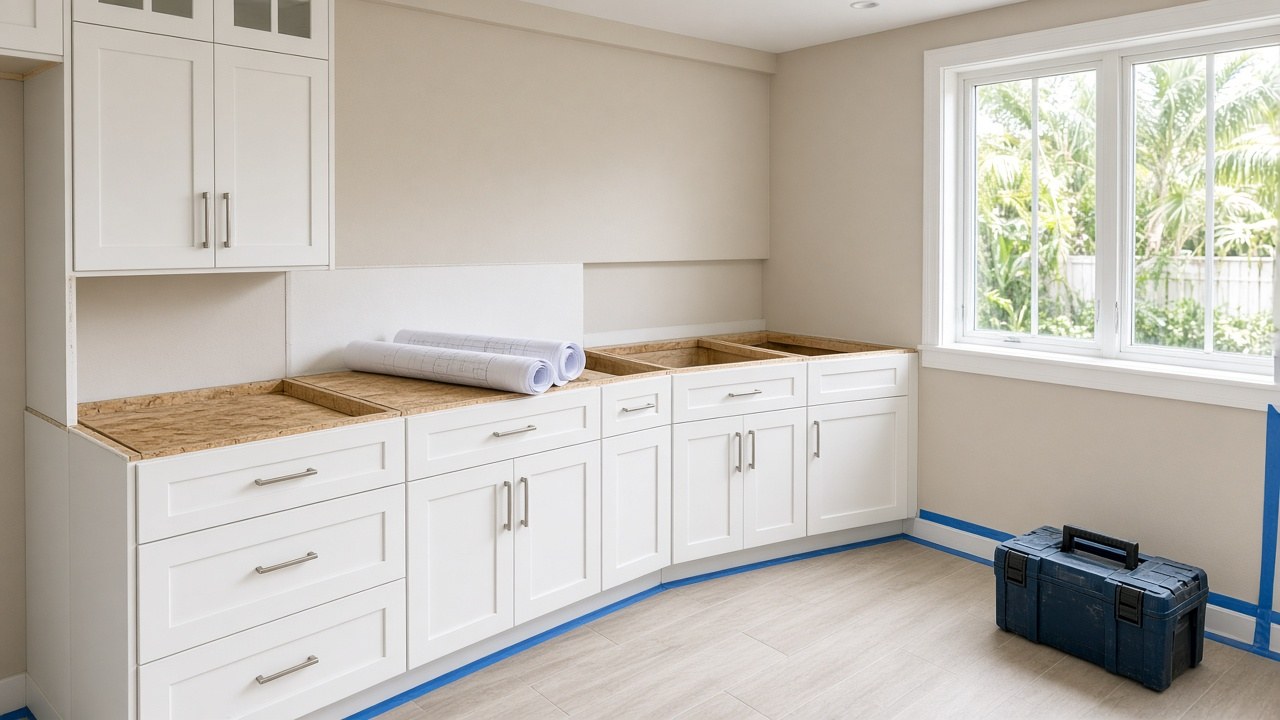
H&H Signature Renovations’ kitchen remodeling page describes designing and building the whole kitchen start to finish—layout, cabinetry, countertops, islands, lighting, plumbing, and electrical—with a written scope. Material choice belongs inside that full scope, not as a standalone slab decision.
For timeline context once materials are chosen, see kitchen remodel timeline Palm Beach. For a project walkthrough, see inside a luxury kitchen remodel in Palm Beach County.
A short checklist before you buy
- Confirm the material category in writing: engineered quartz, granite, or quartzite.
- For anything labeled quartzite, ask for glass and acid verification on a sample.
- Ask whether the slab needs sealing, how often, and which sealer the fabricator recommends.
- View the slab in strong natural light, not only under showroom lights.
- Decide indoor vs. outdoor use before you order; heat and UV rules differ by product.
- Match the countertop decision to the full kitchen scope—cabinets, plumbing, and layout—not the slab alone.
Soft next step
Planning a kitchen remodel in Palm Beach County and weighing quartz, quartzite, or granite? Request a consultation with H&H Signature Renovations, or call (561) 888-4488. Countertops are part of the full kitchen remodeling scope on the live service page—not a standalone drop-in.
FAQ
What is the difference between quartz and quartzite?
Quartz countertops are usually engineered surfaces (crushed quartz plus resin). Quartzite is natural stone. The Natural Stone Institute warns against confusing the two names.
Does granite need sealing in Florida?
Granite in the stone group the Natural Stone Institute describes has low absorption. Impregnating sealers are sometimes used to further reduce staining. Follow your fabricator’s care sheet for the specific granite you buy.
Will quartzite etch from lemon or vinegar?
True quartzite will not etch from those kitchen acids. If a stone labeled quartzite etches, it is mislabeled.
Is engineered quartz good for outdoor kitchens in South Florida?
Treat outdoor use as a product-specific question. Confirm the manufacturer’s outdoor guidance on the brand sheet before you order.
How do countertops fit an H&H kitchen remodel?
H&H’s kitchen remodeling page lists countertops among the scope items in a whole-kitchen project. Start with a consultation.
Sources
- Natural Stone Institute — What Is Granite? — https://www.naturalstoneinstitute.org/consumers/varieties/granite/
- Natural Stone Institute — Care & Cleaning of Natural Stone — https://www.naturalstoneinstitute.org/consumers/care/
- MIA+BSI / Natural Stone Institute — Quartzite Need Not be a Confusing Stone (Technical Bulletin, Vol. VIII, Issue I, June 2017). PDF hosted on percocomarble.com (not on NSI’s site) — https://percocomarble.com/resources/nsi/8.1_quartzite_tech_bulletin_final.pdf
- Caesarstone US — Care & Maintenance (Fusion, Mineral & Quartz Surfaces) — https://www.caesarstoneus.com/care-maintenance/